

Industras

เวที ASEAN MedTech : อุตสาหกรรมอุปกรณ์การแพทย์

Share with

ตลาดอุปกรณ์ทางการแพทย์ในสมาคมประชาชาติแห่งเอเชียตะวันออกเฉียงใต้ (อาเซียน) นับว่าเป็นดินแดนแทบทวีปที่เติบโตรวดเร็วที่สุดแห่งหนึ่งของโลก ขับเคลื่อนโดยปัจจัยพื้นฐานทางเศรษฐกิจมหภาคที่แข็งแกร่ง การเปลี่ยนแปลงทางประชากร และค่าใช้จ่ายด้านการดูแลสุขภาพที่เพิ่มขึ้น ทำให้ตลาดเอเชียแปซิฟิกโดยรวมมีมูลค่าประมาณ 78,250 ล้านดอลลาร์สหรัฐในปี 2024 และมีแนวโน้มว่าจะเติบโตถึง 147,770 ล้านดอลลาร์สหรัฐภายในปี 2031 ด้วยการเติบโตขยายตัวดังกล่าวนี้ ประเทศไทยจึงกลายเป็นตลาดสำคัญและสร้างแบรนด์ให้ตัวเองเป็นศูนย์กลางทางการแพทย์ของเอเชีย ตลาดของประเทศไทยมีมูลค่าถึง 2,230 ล้านดอลลาร์สหรัฐในปี 2024 ซึ่งขับเคลื่อนโดยภาคการท่องเที่ยวระดับโลก ประชากรสูงอายุที่เพิ่มขึ้นอย่างรวดเร็ว และการสนับสนุนจากรัฐบาลทีผ่านโครงการ Thailand 4.0 และ Medical Hub อย่างไรก็ตาม ตลาดของประเทศไทยมีความย้อนแย้งภายในตัวเอง กล่าวคือ ในขณะที่ประเทศไทยเป็นผู้ส่งออกอุปกรณ์ทางการแพทย์รายใหญ่ที่สุดของอาเซียน การผลิตในประเทศกลับมุ่งเน้นไปที่วัสดุสิ้นเปลืองที่ใช้เทคโนโลยีต่ำถึงปานกลาง ดังนั้น ประเทศจึงยังคงต้องพึ่งพาการนำเข้าอุปกรณ์ที่มีความซับซ้อนและมีมูลค่าสูงอย่างมาก ซึ่งจำเป็นต่อการให้บริการดูแลสุขภาพระดับพรีเมียม
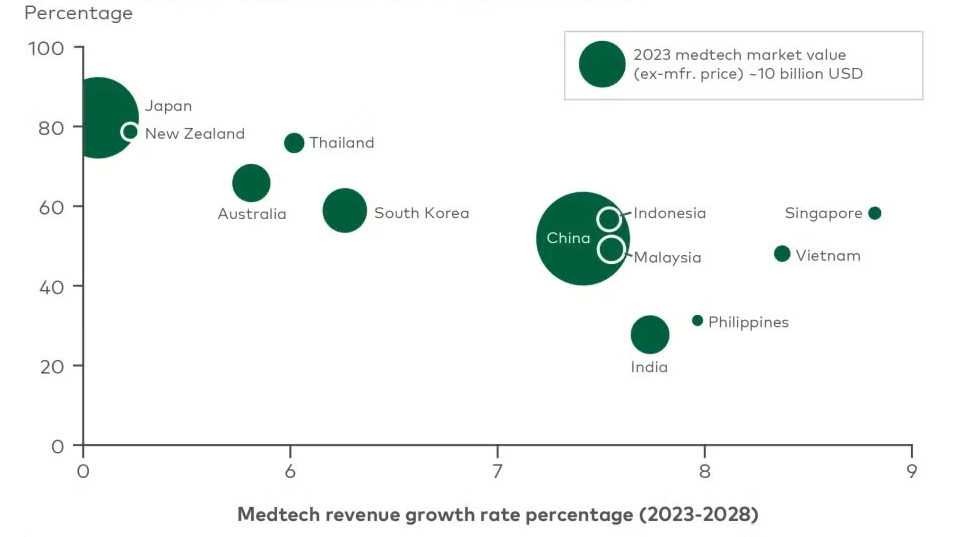
Medtech revenue growth rate percentage, 2023 - 2028  
The ASEAN MedTech Arena: The Medical Device Industry
Source: International Monetary Fund, WEO database; The World Bank; Undata; Eurostat; Statista 2024, L.E.K. Consulting

ตามรายงานของ L.E.K. Consulting และ GlobalData เอเชียตะวันออกเฉียงใต้โดดเด่นในฐานะตลาดย่อยที่เติบโตเร็วที่สุดแห่งหนึ่ง คาดว่าการใช้จ่ายด้านการดูแลสุขภาพในประเทศอาเซียนจะเพิ่มขึ้นอย่างมีนัยสำคัญ 6% ถึง 10% ต่อปีจากปี 2022 ถึง 2032 จึงน่าสนใจสำหรับการด้าน MedTech ทั่วโลก ความต้องการสูงเป็นพิเศษในเซกเม้นท์ ตัวอย่างเช่น ตลาดการวินิจฉัยทางการแพทย์ของอาเซียนมีแนวโน้มการเติบโตอย่างแบบพุ่งทะยาน คาดว่าจะขยายตัวจากประมาณ 11.46 พันล้านดอลลาร์สหรัฐในปี 2024 เป็น 18.42 พันล้านดอลลาร์สหรัฐในปี 2028
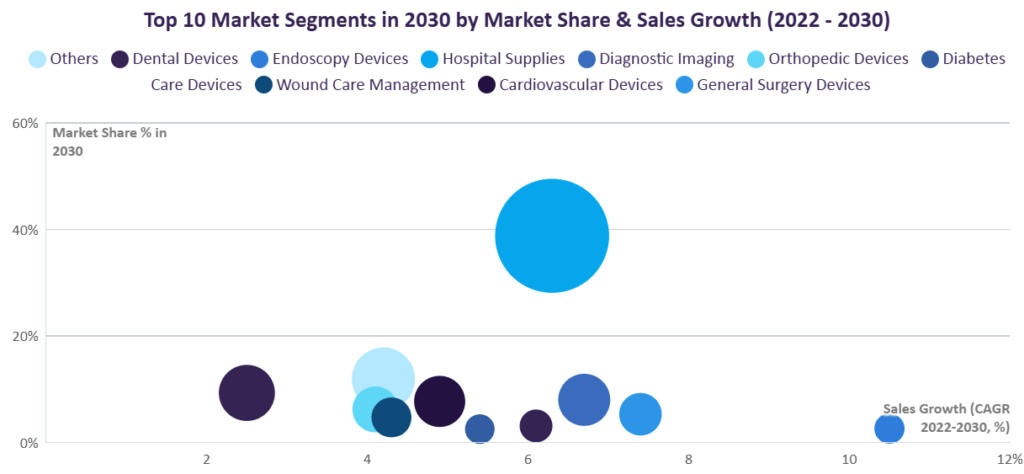
Top 10 market segments in 2030 by market share and sales growth in percentage, 2022 – 2030  
The ASEAN MedTech Arena: The Medical Device Industry
Source: APAC Medical Device Market Outlook, GlobalData’s Medical Device database

วิธีทำความเข้าใจตลาดอาเซียนได้ดีที่สุดนั้น คือการมองตลาดอาเซียนแบบระบบนิเวศหลายชั้นที่ประเทศสมาชิกได้พัฒนาบทบาทเฉพาะทางที่ส่งเสริมซึ่งกันและกัน โครงสร้างแบบหลายชั้นนี้มีความหมายอย่างลึกซึ้งต่อกลยุทธ์ขององค์กร โดยมีอิทธิพลต่อการตัดสินใจว่าจะตั้งศูนย์วิจัยและพัฒนา การผลิต และการดำเนินการเชิงพาณิชย์ที่ใด

ระดับที่ 1: ศูนย์กลางนวัตกรรมและบัญชาการ (สิงคโปร์) สิงคโปร์ทำหน้าที่เป็นศูนย์กลางของอุตสาหกรรม MedTech ของอาเซียนอย่างไร้ข้อกังขา ทำหน้าที่เป็นศูนย์กลางระดับภูมิภาคสำหรับการวิจัยและพัฒนา การเงิน และสำนักงานใหญ่ทางการค้า และทำหน้าที่เป็นประตูสู่บริษัทข้ามชาติ (MNC) ที่ต้องการเข้าถึงภูมิภาคเอเชียตะวันออกเฉียงใต้ อีกทั้งเป็นที่ตั้งของศูนย์วิจัยและพัฒนาของบริษัท MedTech ระดับโลกมากกว่า 30 แห่ง รวมถึง Becton Dickison, Alcon และ Hill-Rom ภาคส่วน MedTech มีส่วนสนับสนุนทางเศรษฐกิจที่สำคัญ โดยสร้างผลผลิตการผลิตได้ประมาณ 19,000 ล้านสิงคโปร์ (ประมาณ 14,000 ล้านดอลลาร์สหรัฐ) ในปี 2022 สิงคโปร์เป็นผู้ส่งออกอุปกรณ์ทางการแพทย์เทคโนโลยีสูง โดยส่งออกอุปกรณ์ประมาณ 70% ของอุปกรณ์ทางการแพทย์ที่นำเข้า และเป็นผู้นำในภูมิภาคในด้านค่าใช้จ่ายด้านการดูแลสุขภาพต่อหัว ซึ่งสะท้อนถึงระบบการดูแลสุขภาพขั้นสูงของประเทศ

ระดับที่ 2: แหล่งผลิตและส่งออกที่สำคัญ (มาเลเซียและไทย) ระดับนี้ประกอบด้วยประเทศที่มีศักยภาพในการผลิตที่แข็งแกร่ง\เป็นศูนย์กลางการผลิตระดับภูมิภาคและระดับโลก มาเลเซียประสบความสำเร็จในการวางตำแหน่งตัวเองให้เป็นศูนย์กลางการผลิตที่มีมูลค่าสูง โดยเป็นผู้ส่งออกอุปกรณ์อิเล็กทรอนิกส์ทางการแพทย์เกินดุลการค้าถึง 747 ล้านเหรียญสหรัฐในปี 2023 ขับเคลื่อนจากผลิตภัณฑ์ที่ซับซ้อน เช่น อุปกรณ์วินิจฉัยด้วยไฟฟ้า อุปกรณ์เอกซเรย์ และเครื่องกระตุ้นหัวใจ โดยส่วนใหญ่ผลิตโดยบริษัทข้ามชาติ เช่น Boston Scientific และ Philips ซึ่งทั้ง 2 บริษัทนี้ได้รับประโยชน์จากสภาพแวดล้อมทางธุรกิจที่เอื้ออำนวยของมาเลเซียสำหรับการส่งออกทั่วโลก อีกทั้งยังพัฒนาภาคการท่องเที่ยวเชิงการแพทย์อีกด้วย สำหรับประเทศไทย เมื่อพิจารณาจากมูลค่าแล้ว ประเทศไทยเป็นผู้ส่งออกอุปกรณ์ทางการแพทย์รายใหญ่ที่สุดของอาเซียนและเป็นศูนย์กลางการผลิตและการกระจายสินค้าที่สำคัญสำหรับภูมิภาค อย่างไรก็ตาม ความสามารถในการผลิตของประเทศไทยมุ่งเน้นไปที่สินค้าแบบใช้ครั้งเดียวใช้มีเทคโนโลยีต่ำที่เน้นปริมาณมาก เช่น ถุงมือทางการแพทย์ เข็มฉีดยา และสายสวน ซึ่งใช้ประโยชน์จากวัตถุดิบที่มีอยู่มากมาย เช่น ยางและพลาสติก ไทยยังคงต้องพึ่งพาการนำเข้าเทคโนโลยีทางการแพทย์ขั้นสูงเกือบทั้งหมด
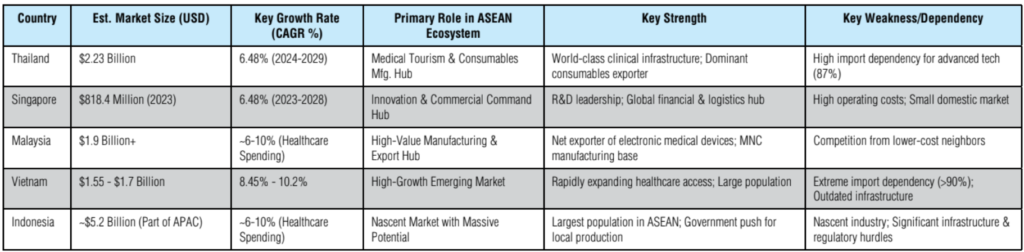

The ASEAN MedTech Arena: The Medical Device Industry

ระดับ 3: ตลาดที่มีการเติบโตสูงและพึ่งพาสูง (เวียดนามและอินโดนีเซีย) มีลักษณะเด่นคือมีประชากรจำนวนมาก เศรษฐกิจเติบโตอย่างรวดเร็ว และอุตสาหกรรม MedTech ที่เพิ่งเริ่มต้น ซึ่งสร้างศักยภาพในการเติบโตมหาศาล คาดว่าตลาดเวียดนามจะเติบโตที่อัตรา CAGR สูงระหว่าง 8.45% ถึง 8.62% จนถึงปี 2030 การเติบโตนี้เป็นผลจากการพลักดันของรัฐบาลที่จะปรับปรุงระบบการดูแลสุขภาพ ซึ่งปัจจุบันอุปกรณ์ทางการแพทย์มากกว่า 90% เป็นการนำเข้า และการผลิตในประเทศตอบสนองความต้องการทั้งหมดเพียง 10%  เท่านั้น นี่คือโอกาสสำคัญสำหรับบริษัทต่างชาติที่มีโซลูชันที่สามารถตอบสนองความต้องการด้านการดูแลสุขภาพที่ขยายตัวของประเทศ สำหรับประเทศอินโดนีเซียแล้ว เนื่องจากเป็นประเทศที่มีประชากรมากเป็นอันดับสี่ของโลก อินโดนีเซียจึงถือการเข้าถึงตลาดอินโดนีเซียจึงถือเป็นชัยชนะที่ยิ่งใหญ่ในระยะยาว เพราะอุตสาหกรรมอุปกรณ์ทางการแพทย์ยังอยู่ในช่วงเริ่มต้นและยังต้องพึ่งพาการนำเข้าอุปกรณ์เทคโนโลยีขั้นสูงเป็นอันมาก เช่น เครื่องสแกน CT และเครื่องช่วยหายใจ แม้รัฐบาลได้ส่งเสริมการผลิตในท้องถิ่นอย่างเต็มที่ดังที่เห็นได้จากความร่วมมือล่าสุดระหว่าง GE Healthcare และ Kalbe Farma ในการสร้างโรงงานผลิตเครื่องสแกน CT ในท้องถิ่น ถึงกระนั้นก็ตามช่องว่างด้านเทคโนโลยีและโครงสร้างพื้นฐานยังมีอยู่สูง
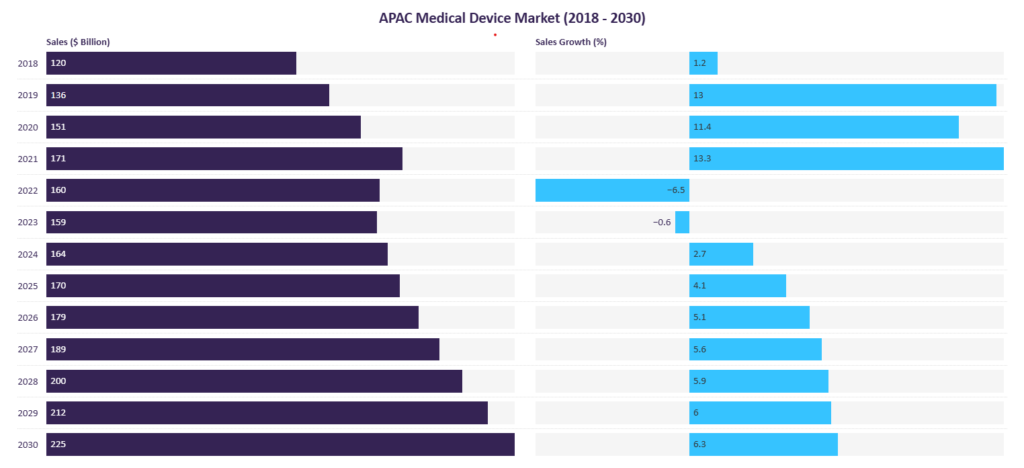
APAC medical device market and sales in USD billion, 2018 – 2030 
The ASEAN MedTech Arena: The Medical Device Industry
Source: APAC Medical Device Market Outlook, GlobalData’s Medical Device database

สรุป

ภายในปี 2030 แรงกดดันด้านการแข่งขันจะมาก (1) มาเลเซียที่มีความก้าวหน้าทางเทคโนโลยี (2) สิงคโปร์ที่ขับเคลื่อนด้วยนวัตกรรม (3) การผลิตของจีนที่ซับซ้อนมากขึ้น และ (4) การแข่งขันด้านราคา จะส่งผลให้การแข่งขันทวีความรุนแรงมากยิ่งขึ้น กลยุทธที่สำคัญที่สุดของไทยคือการใช้ประโยชน์จากสินทรัพย์ที่เป็นเอกลักษณ์อย่างแท้จริงเพียงหนึ่งเดียวของไทย นั่นคือระบบนิเวศทางคลินิกระดับโลก เพื่อไต่อันดับขึ้นไปในห่วงโซ่คุณค่าทางเทคโนโลยี หากสามารถส่งเสริมความร่วมมืออย่างใกล้ชิดระหว่างโรงพยาบาลชั้นยอดกับอุตสาหกรรมอุปกรณ์การแพทย์ที่เพิ่งเริ่มเติบโต เพื่อขับเคลื่อนนวัตกรรมเชิงคลินิกได้สำเร็จ ก็จะสามารถรับประกันอนาคตที่ยืดหยุ่นและมั่งคั่งได้ แต่หากทำไม่สำเร็จ ก็จะเสี่ยงที่จะเป็นเพียงตลาดทำกำไรสูง แต่ในท้ายที่สุดแล้วต้องพึ่งพาเทคโนโลยีจากต่างประเทศ เป็นเพียงผู้ใช้งานระดับโลกแต่ไม่ใช่ผู้สร้างนวัตกรรมทางการแพทย์ยุคต่อไป

Article by: Asst. Prof. Suwan Juntiwasarakij, Ph.D., Senior Editor & MEGA Tech
The ASEAN MedTech Arena: The Medical Device Industry

Share with

The medical device market in the Association of Southeast Asian Nations (ASEAN) represents one of the world’s most dynamic growth frontiers, propelled by strong macroeconomic fundamental, demographic shifts, and increasing healthcare expenditure. The broader Asia-Pacific market was valued at approximately USD 78.25 billion in 2024 and is on a trajectory to reach USD 147.77 billion by 2031. With this expansive region, Thailand has emerged as a pivotal market, branding itself as the medical hub of Asia. Thailand’s market reaches USD 2.23 billion in 2024, driven by a world-class tourism sector, a rapidly aging population, and robust government support through the Thailand 4.0 and Medical Hub initiatives. However, the market Is defined by a central paradox: while Thailand is ASEAN’s largest exporter of medical devices, its domestic manufacturing is concentrated in low-to-mid-technology consumables. Consequently, it remains heavily dependent on imports for the sophisticated, high-value equipment required to sustain its premium healthcare services.

Medtech revenue growth rate percentage, 2023 - 2028  
The ASEAN MedTech Arena: The Medical Device Industry
Source: International Monetary Fund, WEO database; The World Bank; Undata; Eurostat; Statista 2024, L.E.K. Consulting

According to L.E.K. Consulting and GlobalData’s reports, Southeast Asia stands out as one of the most rapidly growing sub-markets. Healthcare spending across the major ASEAN countries is projected to increase by a significant 6% to 10% annually between 2022 and 2032, making it a focal point for global MedTech investment. The demand is particularly acute in specific segments. The ASEAN medical diagnostics market, for example, is on a remarkable growth trajectory, forecast to expand from an estimated USD 11.46 billion in 2024 to USD 18.42 billion by 2028.

Top 10 market segments in 2030 by market share and sales growth in percentage, 2022 – 2030  
The ASEAN MedTech Arena: The Medical Device Industry
Source: APAC Medical Device Market Outlook, GlobalData’s Medical Device database

The ASEAN market is best understood not as a single entity but as a multi-tiered ecosystem where member states have developed specialized, often complementary, roles. This tiered structure has profound implications for corporate strategy, influencing decision on where to locate R&D, manufacturing, and commercial operations.

Tier 1: Innovation & Command Hub (Singapore). Singapore functions as the undisputed nerve center of the ASEAN MedTech industry. It is the regional premier hub for R&D, finance, and commercial headquarters, serving as a gateway for multinational corporations (MNCs) seeking access to Southeast Asia. It is home to R&C centers for over 30 global MedTech firms, including Becton Dickison, Alcon, and Hill-Rom. Its MedTech sector is a significant economic contributor, generating approximately SGC 19 billion (approximately USD 14 billion) in manufacturing output in 2022. Singapore is a net exporter of high-technology medical devices, strategically re-exporting around 70% of its imports, and leads to the region in per-capita healthcare expenditure, reflecting its advanced healthcare system.

Tier 2: Manufacturing and Export Powerhouse (Malaysia & Thailand). This tier consists of countries with strong manufacturing capabilities that serve as regional and global production centers. Malaysia: The country has successfully positioned itself as a hub for higher-value manufacturing. It is a net exporter of medical electronic devices, reporting a trade surplus of USD 747 million in 2023. This is driven by the production of sophisticated products like electro-diagnostic equipment, X-ray devices, and pacemakers, largely by MNCs such as Boston Scientific and Philips that leverage Malaysia’s favorable business environment for global export. Malaysia is also actively developing its medical tourism sector. Thailand: By value, Thailand is ASEAN’s largest exporter of medical devices and crucial manufacturing and distribution center for region. However, its manufacturing prowess is concentrated in lower-technology, high-volume single-use items like medical gloves, syringes, and catheters, which leverage its abundant supply of raw materials like rubber and plastic. The nation remains critically dependent on imports for nearly all its advanced medical technology.


The ASEAN MedTech Arena: The Medical Device Industry

Tier 3: High-Growth, High-Dependency Markets (Vietnam & Indonesia). These nations are characterized by their large population, rapidly growing economies, and nascent MedTech industries, creating enormous potential for growth. Vietnam: The Vietnamese market is projected to grow at blistering CAGR of between 8.45% and 8.62% through 2030. This growth is fueled by a government push to modernize a healthcare system where over 90% of medical equipment is currently imported and domestic production meets only 10% of total demand. This created a massive greenfield opportunity for foreign firms with solutions that can meet the country’s expanding healthcare needs. Indonesia: As the fourth most populous country in the world, Indonesia represent a colossal long-term strategic prize. Its medical device industry is still in its early stages and remains heavily reliant on imports for high-tech equipment like CT scanners and ventilators. While the government is actively promoting local manufacturing, as seen in the recent partnership between GE Healthcare and Kalbe Farma to establish a local CT scanner production facility, the technology and infrastructure gap remains vast.

APAC medical device market and sales in USD billion, 2018 – 2030 
The ASEAN MedTech Arena: The Medical Device Industry
Source: APAC Medical Device Market Outlook, GlobalData’s Medical Device database

In conclusion, by 2030, the competitive pressure from a technologically advancing Malaysia, an innovation-driven Singapore, and increasingly sophisticated and price-competitive Chinese manufacturing will only intensify. Thailand’s greatest strategic imperative is to leverage its one truly unique asset, its world-class clinical ecosystem, to climb the technology value chain. If it can successfully foster closer collaboration between its excellent hospitals and its nascent device industry to drive clinically informed innovation, it can secure a more resilient and prosperous future. If not, it risks remaining a highly lucrative but ultimately dependent market for foreign technology, a world-class user but not a creator of the next generation of medical innovations.

Article by: Asst. Prof. Suwan Juntiwasarakij, Ph.D., Senior Editor & MEGA Tech
The ASEAN MedTech Arena: The Medical Device Industry

Share with

The medical device market in the Association of Southeast Asian Nations (ASEAN) represents one of the world’s most dynamic growth frontiers, propelled by strong macroeconomic fundamental, demographic shifts, and increasing healthcare expenditure. The broader Asia-Pacific market was valued at approximately USD 78.25 billion in 2024 and is on a trajectory to reach USD 147.77 billion by 2031. With this expansive region, Thailand has emerged as a pivotal market, branding itself as the medical hub of Asia. Thailand’s market reaches USD 2.23 billion in 2024, driven by a world-class tourism sector, a rapidly aging population, and robust government support through the Thailand 4.0 and Medical Hub initiatives. However, the market Is defined by a central paradox: while Thailand is ASEAN’s largest exporter of medical devices, its domestic manufacturing is concentrated in low-to-mid-technology consumables. Consequently, it remains heavily dependent on imports for the sophisticated, high-value equipment required to sustain its premium healthcare services.

Medtech revenue growth rate percentage, 2023 - 2028  
The ASEAN MedTech Arena: The Medical Device Industry
Source: International Monetary Fund, WEO database; The World Bank; Undata; Eurostat; Statista 2024, L.E.K. Consulting

According to L.E.K. Consulting and GlobalData’s reports, Southeast Asia stands out as one of the most rapidly growing sub-markets. Healthcare spending across the major ASEAN countries is projected to increase by a significant 6% to 10% annually between 2022 and 2032, making it a focal point for global MedTech investment. The demand is particularly acute in specific segments. The ASEAN medical diagnostics market, for example, is on a remarkable growth trajectory, forecast to expand from an estimated USD 11.46 billion in 2024 to USD 18.42 billion by 2028.

Top 10 market segments in 2030 by market share and sales growth in percentage, 2022 – 2030  
The ASEAN MedTech Arena: The Medical Device Industry
Source: APAC Medical Device Market Outlook, GlobalData’s Medical Device database

The ASEAN market is best understood not as a single entity but as a multi-tiered ecosystem where member states have developed specialized, often complementary, roles. This tiered structure has profound implications for corporate strategy, influencing decision on where to locate R&D, manufacturing, and commercial operations.

Tier 1: Innovation & Command Hub (Singapore). Singapore functions as the undisputed nerve center of the ASEAN MedTech industry. It is the regional premier hub for R&D, finance, and commercial headquarters, serving as a gateway for multinational corporations (MNCs) seeking access to Southeast Asia. It is home to R&C centers for over 30 global MedTech firms, including Becton Dickison, Alcon, and Hill-Rom. Its MedTech sector is a significant economic contributor, generating approximately SGC 19 billion (approximately USD 14 billion) in manufacturing output in 2022. Singapore is a net exporter of high-technology medical devices, strategically re-exporting around 70% of its imports, and leads to the region in per-capita healthcare expenditure, reflecting its advanced healthcare system.

Tier 2: Manufacturing and Export Powerhouse (Malaysia & Thailand). This tier consists of countries with strong manufacturing capabilities that serve as regional and global production centers. Malaysia: The country has successfully positioned itself as a hub for higher-value manufacturing. It is a net exporter of medical electronic devices, reporting a trade surplus of USD 747 million in 2023. This is driven by the production of sophisticated products like electro-diagnostic equipment, X-ray devices, and pacemakers, largely by MNCs such as Boston Scientific and Philips that leverage Malaysia’s favorable business environment for global export. Malaysia is also actively developing its medical tourism sector. Thailand: By value, Thailand is ASEAN’s largest exporter of medical devices and crucial manufacturing and distribution center for region. However, its manufacturing prowess is concentrated in lower-technology, high-volume single-use items like medical gloves, syringes, and catheters, which leverage its abundant supply of raw materials like rubber and plastic. The nation remains critically dependent on imports for nearly all its advanced medical technology.


The ASEAN MedTech Arena: The Medical Device Industry

Tier 3: High-Growth, High-Dependency Markets (Vietnam & Indonesia). These nations are characterized by their large population, rapidly growing economies, and nascent MedTech industries, creating enormous potential for growth. Vietnam: The Vietnamese market is projected to grow at blistering CAGR of between 8.45% and 8.62% through 2030. This growth is fueled by a government push to modernize a healthcare system where over 90% of medical equipment is currently imported and domestic production meets only 10% of total demand. This created a massive greenfield opportunity for foreign firms with solutions that can meet the country’s expanding healthcare needs. Indonesia: As the fourth most populous country in the world, Indonesia represent a colossal long-term strategic prize. Its medical device industry is still in its early stages and remains heavily reliant on imports for high-tech equipment like CT scanners and ventilators. While the government is actively promoting local manufacturing, as seen in the recent partnership between GE Healthcare and Kalbe Farma to establish a local CT scanner production facility, the technology and infrastructure gap remains vast.

APAC medical device market and sales in USD billion, 2018 – 2030 
The ASEAN MedTech Arena: The Medical Device Industry
Source: APAC Medical Device Market Outlook, GlobalData’s Medical Device database

In conclusion, by 2030, the competitive pressure from a technologically advancing Malaysia, an innovation-driven Singapore, and increasingly sophisticated and price-competitive Chinese manufacturing will only intensify. Thailand’s greatest strategic imperative is to leverage its one truly unique asset, its world-class clinical ecosystem, to climb the technology value chain. If it can successfully foster closer collaboration between its excellent hospitals and its nascent device industry to drive clinically informed innovation, it can secure a more resilient and prosperous future. If not, it risks remaining a highly lucrative but ultimately dependent market for foreign technology, a world-class user but not a creator of the next generation of medical innovations.

Article by: Asst. Prof. Suwan Juntiwasarakij, Ph.D., Senior Editor & MEGA Tech

May June 2019​

Creative Solutions by Professional Designers

+(48) 555-0120-88

hello@example.com

2972 Westheimer Rd. Santa
Ana, Illinois 85486

Main Offices
Monday-Friday: 8am-5pm
Saturday: 9am-Midday
© Industras 2024, All Rights Reserved.